The Pond That Breathed
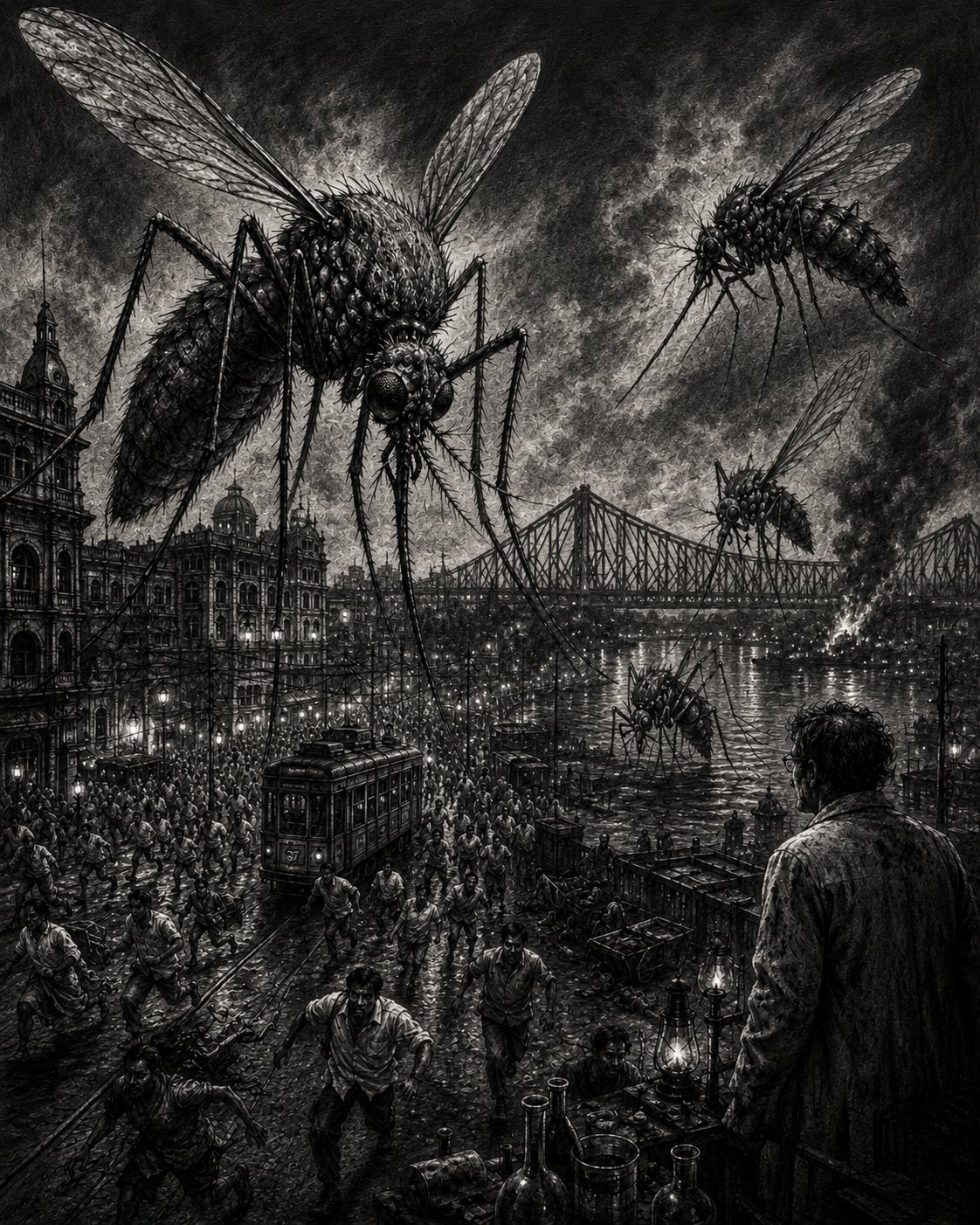
THIS IS A WORK OF FICTION
By half past five, the tea stall beside the Kalighat tram depot had already begun its parliament.
Conductors shouted at autos. A tram wire gave off a tiny blue spit, like an insect’s soul escaping. Rainwater stood in the broken lip of the road, holding floating paan stains, diesel rainbows, a dead matchstick, one orange marigold, and the patient reflection of a political poster promising development in a face that had not developed since 1987.
Haripada Naskar stood under the torn blue tarpaulin of Jhuma’s tea stall with his fogging machine at his feet and a cup of tea too hot to drink. The machine leaked kerosene smell from one joint and shame from all the others.
“Again you people will smoke the para like Kali Puja,” said Jhuma, pouring tea from a height, because tea in Calcutta must be aerated like gossip. “Mosquitoes will sit on the wall and laugh.”
Haripada did not answer. He had heard every joke about the municipal mosquito department. That it killed old men before mosquitoes. That dengue was better organized. That if the Corporation ever sprayed punctuality, it would miss the city and poison Howrah.
He was fifty-three, thin in the tragic way of men who ate enough rice but no peace. His municipal shirt had sweated into maps. His daughter, Mili, had died two monsoons ago of dengue after three clinics, two wrong blood counts, one ambulance argument, and a final hospital bill that still lay in his almirah like a second corpse. Since then, every mosquito whine near his ear felt not like sound but accusation.
A boy ran past the stall, slapped his own neck, and showed his palm.
“Dada,” he said, delighted, “look at the size.”
The smear on his hand was not the usual red dot and grey dust. It was a flattened wing, broad as a betel leaf, and a black leg jointed like a sewing needle.
Jhuma leaned forward. “What is that?”
“Dragonfly baby?” the boy suggested.
From the tram depot came a cry. Not the daily cry of fare dispute or slipped sandal. A deeper tearing cry, as if a man had discovered a new fact about the world and disliked it.
Haripada picked up his machine and ran.
The conductor lay beside tram 24, beating at his own face. Something clung to his cheek: a mosquito, unmistakably a mosquito, but swollen to the length of a finger, its body striped dark and pale, its wings vibrating so fast they blurred. Its proboscis was sunk under his eye. Three men tried to pull it free and then jumped back when it lifted, heavy with blood, and bounced against the tram window with a wet tapping sound.
For a moment everyone became very silent. Calcutta can survive power cuts, floods, price rise, ministers, relatives, and fish bones, but it does not like novelty before breakfast.
Then the mosquito turned in the air.
People scattered.
Haripada swung the fogging hose by instinct. The insect vanished into the white cloud and fell, ticking against the tram rail. It lay there, legs curling and uncurling. Its abdomen throbbed. Not dead. Thinking it over.
“Spray more!” someone shouted.
He did. The white smoke rolled under the tram, over shoes, into the tea stall, around Jhuma’s angry curses.
By seven, twelve such insects had been killed near the depot. By nine, photographs were circulating on phones, but nobody believed photographs anymore. Photographs had become the new ghosts: everywhere, unreliable, and always blamed on someone else.
At eleven, Haripada’s supervisor called.
“Don’t talk to reporters,” said Mr. Bhaduri. “Also don’t say giant mosquito. Say unusual vector specimen.”
“It bit a man under the eye.”
“Then say unusual biting incident.”
“Sir, where are they coming from?”
There was a pause. In the pause Haripada heard ceiling fan blades and someone in Bhaduri’s office eating muri.
“Go to Chandra Pukur,” Bhaduri said. “Complaints from that side also. Take sample. Quietly.”
Chandra Pukur lay behind a new apartment project near Tollygunge, trapped between old houses with cracked balconies and a wall painted with the smiling faces of future luxury residents. The pond was famous for not dying. People had tried to fill it with rubble, puja flowers, plastic chairs, legal notices, and once a stolen scooter. Still it remained, green and secret, breathing under hyacinth.
Haripada knew the place. Mili had once fed muri to the fish there when she was eight, wearing a yellow frock and two fountain-pen braids. She had asked why mosquitoes existed. He had told her, with the confidence of fathers before biology, that everything had some purpose.
He had stopped saying that after the hospital.
At the pond, the air felt wrong.
Not hot. Not cool. Active. It pressed lightly against his face like a damp hand. Bubbles rose from under the hyacinth in steady strings, not the lazy burps of rot but fine silver beads, so many that the surface shimmered.
A bamboo platform had been built behind a screen of tarpaulin. Three blue cylinders stood there, connected by pipes to a black pump sunk into the water. On the wall behind the platform someone had pasted an old cinema poster of a hero pointing a gun. Rain had melted his face until he looked disappointed in everybody.
Haripada knelt by the water.
Larvae hung below the surface by the hundreds.
No. Not hundreds. Thousands.
They were too large. Each the size of a matchstick, some bigger, twitching in commas. When his shadow fell across them, they dropped as one. The whole pond flinched.
Behind him, a voice said, “You should not lean so close.”
Haripada turned.
Dr. Prabir Sen stood in the lane, holding a cloth bag and a black umbrella though no rain was falling. He was short, neatly dressed, with hair combed back from a shining forehead. Haripada recognized him after a second. The scientist from the old Vector Research Institute near Beleghata, often on television panels years ago, explaining dengue in a patient voice while anchors interrupted him with national concern.
Now he looked reduced, like a respected book eaten by silverfish.
“Sir?” Haripada stood. “You live here?”
“I work here.”
“For Corporation?”
Dr. Sen smiled. “The Corporation works nowhere. It occupies space.”
A fair assessment, Haripada thought, though rude.
“These larvae,” Haripada said carefully, “are not normal.”
“No,” Sen said. “Normal is what survives long enough to become boring.”
Haripada felt the old municipal fear rising: that he had stepped into something involving permissions, committees, signatures, men who said “as per rule” before doing wrong. “Sir, we have to treat the pond.”
“With your little smoke machine?”
“We have larvicide.”
Dr. Sen looked almost amused. “You have powder bought by tender from someone’s brother-in-law. Please.”
From the lane came the sound of a scooter stopping. A young woman entered carrying a cloth satchel and a steel tiffin carrier. She wore a faded blue kurta and had the exhausted alertness of someone who worked for a living and still remembered to be kind.
“Doctor, you didn’t eat,” she said, then saw Haripada. Her face changed. “Who is this?”
“Municipal,” Sen said.
The woman’s eyes went to the pond, the pipes, the cylinders, and then away too quickly.
“I am Nandita,” she said. “I help Doctor Sen.”
“With what?”
“Cleaning,” she said.
It was a lie with no bones in it. It fell down immediately.
A mosquito landed on Haripada’s wrist.
Not a giant one. Ordinary, delicate, striped. He slapped it. A dot of blood appeared. His blood.
Dr. Sen watched with uncomfortable intensity.
“You should wash that,” he said.
“Why?”
“Because everything here is experimental.”
The word went through Haripada like fever.
He took samples in three plastic vials, though his hands trembled and he dropped one cap in mud. Nandita picked it up and washed it with water from her bottle.
“Don’t come after dark,” she whispered.
“Why?”
She looked toward the pond.
“They hatch when the pump runs full.”
“Then switch it off.”
Her mouth tightened. “You think nobody thought of switching off a thing?”
In Calcutta, this was almost a proverb.
That afternoon the city became ridiculous first, then afraid. A hawker in Gariahat claimed a mosquito had carried away a baby goat. A retired professor said prehistoric insects had always been predicted by ancient Sanskrit texts. A councillor blamed illegal construction. A rival councillor blamed imported ornamental plants. By evening, three more men had been hospitalized with blood loss and shock. One old woman in Bhowanipore died after being bitten in her sleep; her family discovered a torn mosquito net and a stain on the ceiling fan.
At eight, Bhaduri called again.
“Samples misplaced,” he said.
“I gave them to your peon.”
“Peon says no.”
“I signed register.”
“Register not found.”
Haripada closed his eyes. Somewhere nearby a generator coughed awake. His room smelled of old clothes, mosquito coil, and the damp almirah where Mili’s school prizes were wrapped in newspaper.
“Sir, that pond has equipment. Oxygen cylinders. Pump. Thousands of larvae.”
“Don’t dramatize.”
“People are dying.”
“People die daily.”
It was the sharpest social philosophy of the city, Haripada thought. People die daily; only paperwork is immortal.
He went back without permission.
The lane to Chandra Pukur was darker than usual. Half the streetlights had failed. In balconies, people stood behind grilles, discussing the danger with the luxury of those not yet inside it. Someone had lit incense before a tulsi plant. Someone else had put up a mosquito net over a window and then, not trusting it, taped newspaper over the net.
At Jhuma’s stall, now shuttered, a handwritten sign hung: NO TEA DUE TO BLOODSUCKER SITUATION.
The pond glowed faintly.
Not with light exactly, but with movement. The oxygen bubbles rose so thickly the surface looked carbonated. The pump thudded under the water like a second heart.
Nandita was on the bamboo platform, wrench in hand, trying to loosen a pipe. Her cheek was bruised.
“Go,” she hissed. “He’s inside.”
“In where?”
She pointed to the old single-storey house behind the pond. Its windows were covered with black plastic. A smell came from it: chemical sweetness, wet feathers, and something like overripe guava.
“What is he doing?”
“What he said the city deserved.”
A sound rose from the pond. Thin at first, almost a harmonium note. Then many notes joined. Wings.
Nandita dropped the wrench. “Too late.”
The first wave came out of the hyacinth like blown ash.
They were not all finger-sized. Some were larger, bodies long as a child’s pencil, legs dangling, wings transparent and veined. They flew badly at first, bumping into each other, into the tarpaulin, into the wall. Then the air organized them.
One struck Haripada’s shoulder. He felt its feet grip cloth. Its proboscis punched through his shirt.
Pain opened bright and immediate.
He crushed it with his palm. The body burst hot.
Nandita dragged him behind the pump cylinders. Three mosquitoes hit the metal with hard ticks. One crawled around the cylinder curve, probing.
“Smoke!” she shouted.
He had brought the fogging machine, slung on his back. He yanked the cord. Nothing. Again. The machine coughed like a dying uncle and refused.
“Always government quality,” Nandita said, close to hysteria.
He found the choke, primed it, pulled until his shoulder screamed. The engine caught. White fog exploded from the nozzle. The mosquitoes reeled, dropped, rose again. It slowed them but did not kill enough.
From the black-windowed house came laughter.
Dr. Sen stepped onto the veranda wearing a beekeeper’s veil and rubber gloves. The veil made his face look already dead.
“Beautiful,” he called over the engine noise. “Do you see? They remember. Their bodies remember a larger earth. More oxygen, warmer swamps, generous blood. We made insects small by making the world poor. I have merely restored an inheritance.”
“You’re killing people!” Haripada shouted.
“People killed my work first.”
This was so petty that Haripada almost laughed. Calcutta specialized in apocalypse caused by insult.
“My grant was stopped,” Sen said. “My institute room was given to a man who organized seminars on innovation. My papers were stolen by boys who could not spell larva. I warned them that vector control was collapsing. They smiled. They said budget. They said file. They said later. So I improved the vector.”
A mosquito landed on his veil and rested there like a pet.
Nandita shouted, “Doctor, enough!”
He turned on her. “You were hungry when you came to me.”
“I wanted a job.”
“You wanted revenge also.”
She flinched.
Haripada looked at her.
“My brother died of dengue,” she said, barely audible. “In a private ward we could not afford. Doctor said platelet, plasma, package, package, package. Doctor Sen said they would listen if fear became rich enough.”
“And now?”
“Now he listens only to them.”
The swarm lifted above the pond, thickening. Beyond the wall, people began to scream.
Haripada thought of Mili under a hospital sheet, her hair still tied because his wife had said untied hair looked careless. He thought of the bill. The doctor who had not met his eyes. The relatives who had advised strength as if it were cheap rice. He understood Nandita’s revenge. He understood it so well that for one ugly second it stood inside him and wore his face.
Then a child screamed from the lane.
Not memory. Now.
Haripada ran toward the sound. A little boy had fallen beside the wall, his foot caught under a loose brick. Three mosquitoes circled him, confused by his flailing arms. His mother beat at them with a plastic schoolbag.
Haripada sprayed fog in a wide arc and grabbed the boy. One insect sank its proboscis into Haripada’s neck. He felt warmth spill down his collar, his knees loosen. He tore it away and stumbled back with the child under one arm.
“Take him inside!” he shouted.
The mother did. Then shut the door in his face.
Fair enough, he thought. Calcutta gratitude had limits.
When he returned to the platform, Nandita was wrestling with Sen for a brass valve attached to the oxygen line. He struck her with the wrench. She went down.
Haripada hit him with the fogging nozzle.
Sen fell against the cylinders. His veil tore. For the first time, fear entered his face, small and ordinary.
“You fool,” he whispered. “If the oxygen stops suddenly, they disperse.”
“They are already dispersing.”
“No. The breeders remain below. The queens. Kill me and you learn nothing.”
“Then teach me.”
Sen smiled with bloody teeth. “You cannot stop them with poison. I changed the spiracles, the gut, the blood hunger. I made them follow heat and carbon dioxide, yes, but also a marker. A simple marker. Something your department sprays everywhere. Something on your clothes, your machines, your hands.”
Haripada looked down at his stained shirt.
“The fog attracts them?” he said.
“Not the fog. The additive in your larvicide. I petitioned for that formula for years. Nobody read the appendix. Nobody reads anything here except exam guides and property deeds.”
The ordinary clues aligned: the tram depot after morning spray, the bites around treated drains, the way the mosquito had landed on his wrist, the missing samples, the city itself baited by its own cheap prevention.
He was not fighting the swarm.
He was calling it.
Nandita, on the ground, opened her eyes. “The pump,” she whispered. “Below it. Eggs in trays.”
Haripada saw the black cable running from the pump house to the bamboo platform, tied with plastic rope. He saw the oxygen cylinders, the valve, the pipe feeding the pond’s silver breath. He saw, leaning against the wall, his own leaking fogging machine, faithful and stupid.
He knew what he had to do. Not because he was brave. Bravery is too clean a word. He did it because Mili had once asked why mosquitoes existed, and he had answered badly, and fathers are foolish enough to keep correcting themselves after the child is gone.
He opened the fogger’s fuel cap and poured kerosene over the bamboo platform.
Sen tried to crawl away.
Nandita grabbed his ankle.
“Don’t,” Sen pleaded. “This is discovery.”
“This is Calcutta,” Nandita said. “Discovery also needs permission.”
Haripada struck a match.
The platform caught slowly, then all at once. Flame ran under the pipes, up the tarpaulin, along the bamboo with dry cracks. Heat pressed him back. The oxygen line hissed. Mosquitoes, drawn by the marker on his clothes, came at him in a dark funnel.
He ran into the shallow edge of the pond.
The water swallowed him to the waist, warm as fever. Larvae brushed his legs in living threads. He forced himself forward, toward the pump. Mosquitoes landed on his head, neck, hands. He went under.
The pond below was green-black and full of bubbles. He found the pump by its vibration, found the cable, found the trays Nandita had mentioned: plastic racks tied beneath the platform, each heavy with gelatinous strings of eggs.
His lungs began to burn.
Above, firelight trembled on the surface. Mosquito bodies dimpled the water, trying to pierce even his submerged skin.
He pulled the trays free. One stuck. He yanked until something tore in his shoulder. The tray came loose, struck his face, and spilled its pale beads into the dark.
He rose into flame-colored air.
Nandita stood on the bank, coughing, holding the brass valve. Behind her the oxygen cylinders screamed. Sen was on his knees, slapping at his own bare face. His pets had found him.
Haripada threw the egg tray into the fire.
The cylinder nearest the pump burst not like cinema but like judgment: a flat, enormous crack that knocked him under again and slapped the pond outward. Windows shattered. The bamboo platform flew apart. Fire dropped into the water and died in patches of steam.
When Haripada crawled out, the swarm was no longer a swarm. It was confusion, scattered bodies, burning wings, insects spiraling into walls, into water, into the hot white fog of their own ending.
Sen lay near the veranda. Mosquitoes covered him so completely he seemed to be wearing a moving shawl. He was still alive. His mouth opened and closed, perhaps explaining.
By dawn, the officials arrived with masks, notebooks, and the grave expressions of men preparing to discover what everyone had told them yesterday. They sealed the pond. They removed cylinders. They denied panic. They praised coordination. They said the situation was under control, which meant the situation had finally frightened someone important.
Bhaduri came at nine.
“You did unauthorized burning of municipal-adjacent property,” he said.
Haripada sat on a broken step, neck bandaged, hands swollen, shirt stiff with blood and pond water. Nandita sat beside him with a blanket around her shoulders.
“Write memo,” Haripada said.
Bhaduri looked at the pond. Dead larvae floated in pale mats. Among them drifted something yellow: a child’s old plastic hair clip, shaped like a butterfly.
Haripada knew it before he picked it up.
Mili’s.
She had lost it here years ago, crying until he promised the fish would wear it for Durga Puja. He had forgotten. The pond had not.
He held the clip in his palm, and the final truth came quietly, with no thunder because Calcutta had already used up its noise. Sen had not chosen Chandra Pukur only for secrecy, oxygen, or pipes. He had chosen it because municipal records marked it as a dengue cluster, again and again, year after year. Mili’s fever had begun here. Nandita’s brother had played carrom in this lane. The dead had been local long before the monsters became large enough to see.
All those years, the pond had been breeding small deaths, and everyone had called it normal.
A surviving mosquito whined near Haripada’s ear.
Tiny. Ordinary. Almost tender.
He closed his fist around the yellow clip and did not move until the sound disappeared.